How long a football match lasts: 90 minutes in the laws, about 100 in the Premier League
On paper a match is 90 minutes. Added time, the interval and, in knockout ties, extra time push the real figure well past that. Event data from 3,789 matches shows how often play is still going after 90:00.
Ninety minutes plus added time
The laws give a football match 90 minutes, split into two 45-minute halves by a break that cannot exceed a quarter of an hour (Law 7 of the IFAB Laws of the Game). Almost no match stops there. Referees give back what stoppages took away, and in the Premier League that has pushed the average match to roughly 100 minutes.
Opta timed the average Premier League match at 99 minutes 44 seconds in 2024-25 and at 101 minutes 36 seconds in 2023-24, stoppage time included. After 70 matches of 2025-26 the average stood at 100 minutes 35 seconds. With a full 15-minute interval, that is about an hour and 55 minutes between kick-off and the final whistle.
What the referee adds time for
Law 7 tells the referee to restore the minutes lost to a set list of delays. Changes of players, treatment of the injured, deliberate slowing of the game and bookings are all on it. So are drinks and cooling breaks where a competition permits them, VAR checks, the celebrations after a goal and anything else that holds up a restart.
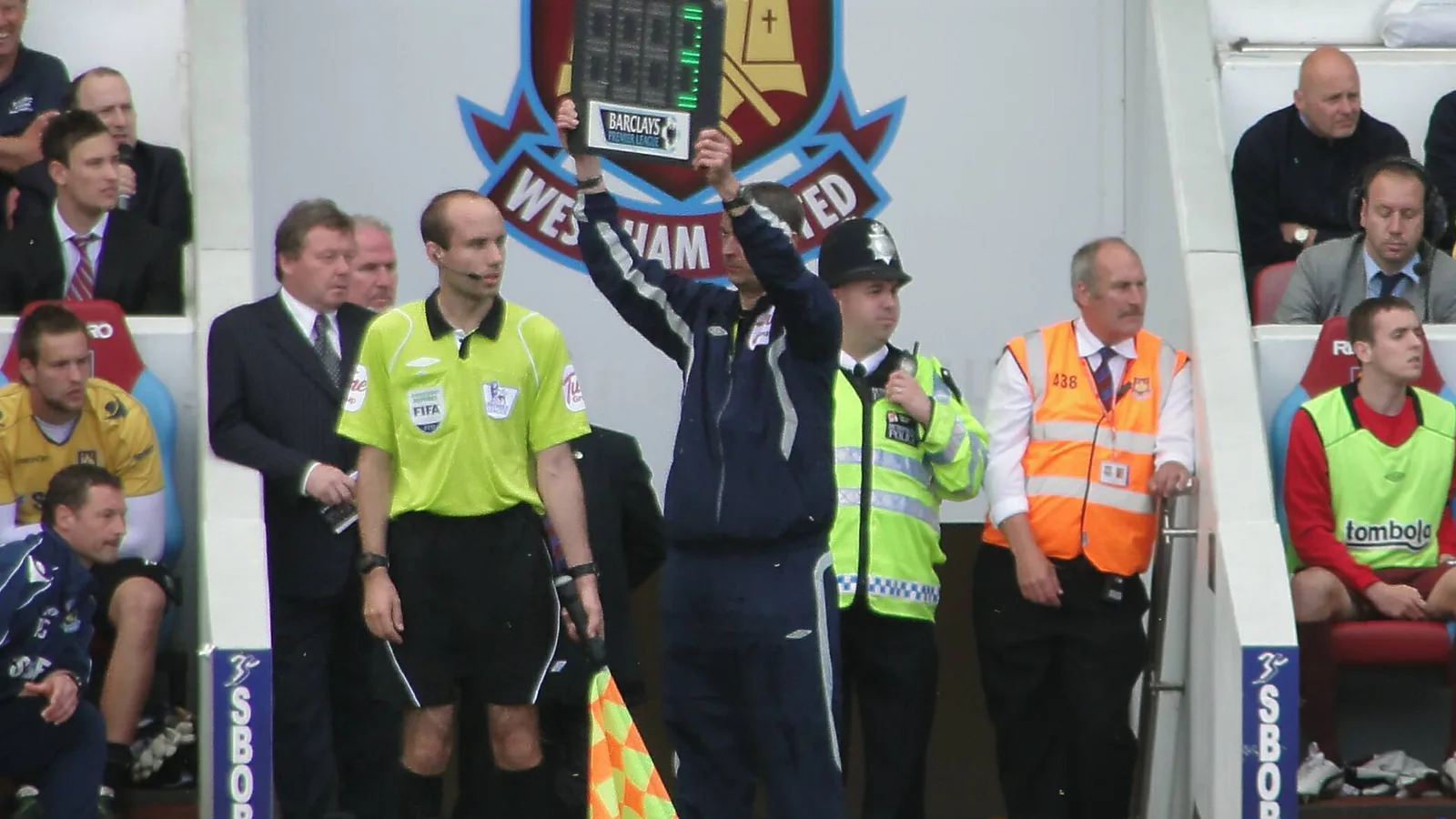
The number on the fourth official's board is a minimum. A referee may play longer than the board says, never shorter, and a penalty given in the dying seconds still has to be taken before the half can close.
In the first 50 Premier League games of 2026-27 added time averaged 8 minutes 4 seconds per game, according to Opta. That is the lowest figure since 2021-22, when it was 7 minutes 29 seconds.
Six matches in ten have an event after 90:00
Our match feed puts a minute on every goal, card, substitution and VAR decision. An event marked 90+1 or later is proof that the match was still being played after the 90th minute. We counted such events in 3,789 finished matches played between 22 November 2025 and 28 November 2026 in ten competitions: the five biggest European leagues, the Champions League with its qualifying rounds, the Championship, the Eredivisie, Liga Portugal and MLS.
In 2,247 of those matches, or 59.3%, at least one event came after 90:00. The Premier League is top of the list with 69.2% (263 matches of 380), and the Eredivisie is bottom with 47.0%. First-half added time is quieter: an event after 45:00 was recorded in 751 matches, or 19.8%. Taking either half, the count is 2,547 matches, or 67.2%.
SportStats data, 22 November 2025 to 28 November 2026. Goals, cards, substitutions and VAR decisions in second-half added time.
These shares are a floor, and they do not measure added time itself. A stoppage period without a goal, a card or a substitution leaves nothing in the event log, even though the players were on the pitch after 90:00.
How deep into added time matches go
Where a match has an event after 90:00, the last one is recorded on average 4.3 minutes into added time. The Premier League average is 4.9 minutes, the Champions League's 3.4. The log reaches 90+5 or later in 928 matches, 24.5% of the whole sample. It reaches 90+8 in 233 matches (6.1%) and 90+10 in 88 (2.3%).
The latest goal in the sample came at 90+15: Mateusz Bogusz scored it in March 2026 to give Houston Dynamo a 3-2 win over Portland Timbers in MLS. The latest Premier League events are timed at 90+13. One is Dominik Szoboszlai's red card in Liverpool's 2-1 home defeat by Manchester City on 8 February 2026, the other a VAR decision in Burnley v Brentford on 28 February.
Cards and changes fill most of this period. After 90:00 the ten competitions produced 1,935 yellow cards, 1,269 substitutions, 775 goals, 165 red cards (second yellows included), 104 VAR decisions and 34 missed penalties.
One goal in ten is scored in added time
The same matches produced 11,217 goals. Of those, 775 were scored after 90:00, which is 6.9%. Another 346, or 3.1%, came in first-half added time, and 21 were scored in extra time. Added time alone accounts for 1,121 goals, one in ten.
SportStats data, 22 November 2025 to 28 November 2026. 21 extra-time goals are left out.
For scale, minutes 81 to 90 brought 1,209 goals. Second-half added time, which is rarely as long as ten minutes, brought 64% of that number. At least one goal after 90:00 was scored in 720 matches, 19.0% of the sample, so nearly every fifth match has a goal that a 90-minute clock would not have allowed.
Levante v Sevilla in La Liga on 12 October 2026 is the extreme case. Sevilla led 2-1 when the 90 minutes were up. Three goals followed, at 90+2, 90+5 and 90+10, and the match ended 3-3.
SportStats data, 22 November 2025 to 28 November 2026. Penalties and own goals included.
The Premier League (88 goals of 1,050, or 8.4%) and La Liga (90 of 1,084, or 8.3%) score most often after 90:00. The Champions League is last with 4.6%, 47 goals of 1,011, and the Championship is next to last with 5.1%.
The ball is in play for less than an hour
A match of about 100 minutes does not contain 100 minutes of football. Opta puts the average time the ball was in play in the Premier League at 55 minutes 23 seconds in 2025-26, 56 minutes 59 seconds in 2024-25 and 58 minutes 11 seconds in 2023-24.
Over the first 50 games of 2026-27 the ball was in play for 56 minutes 35 seconds per game, or 57.7% of match time. The rest is stoppages. In the first 70 matches of 2025-26 Opta counted 45 minutes 35 seconds of delays and pauses per game.
Extra time and penalties
A knockout tie that is level when normal time runs out can, under Law 10, be extended by two further periods capped at 15 minutes apiece. A shoot-out follows if nothing separates the sides by then: five kicks per team, then one pair of kicks at a time until somebody leads.
That adds up to half an hour of play, but only to a small share of matches. In the Champions League, the Europa League and the Conference League, qualifying included, 54 matches of 1,013 in our sample went beyond normal time, or 5.3%. Thirty of them were settled in extra time and 24 went to penalties. The extra periods of those 54 matches brought 63 goals.
SportStats data, 22 November 2025 to 28 November 2026. Champions League, Europa League and Conference League, qualifying included.
Extra time has its own stoppage time. In the Conference League play-off between Hradec Králové and Panathinaikos on 27 August 2026 the Greek side scored from the penalty spot at 120+5 to win 2-1, and the last yellow card of the night was shown at 120+9.
Sources
- IFAB, Laws of the Game: Law 7, The Duration of the Match
- IFAB, Laws of the Game: Law 10, Determining the Outcome of a Match
- Opta Analyst: Premier League ball-in-play time, 2025-26
- Opta Analyst: Premier League throw-ins, goal kicks and ball in play, 2026-27
- SportStats data: match events, ten competitions
- SportStats data: La Liga matches
- SportStats data: UEFA club competitions